Blog
What Aaron Rai's PGA Win Can Teach Every Meta Ads Specialist
Aaron Rai just went wire-to-wire at the PGA Championship. Two gloves, iron covers, and 72 holes of data-driven decision-making. Here's what every digital marketer can learn from the way he plays.

AskRocco Team
What Aaron Rai's PGA Win Can Teach Every Meta Ads Specialist
Aaron Rai just went wire-to-wire at the PGA Championship. Two gloves, iron covers, and 72 holes of data-driven decision-making. Here's what every digital marketer can learn from the way he plays.
May 2026 | 7 min read
I was at Aronimink on Friday watching the PGA Championship in person for the first time.
I went for the golf. I left thinking about advertising.
If you didn't follow the PGA Championship this week, here's what you missed. Aaron Rai, a quiet, unassuming guy from England who almost nobody outside of hardcore golf fans had heard of, just went wire-to-wire to win one of the four biggest tournaments in the world. Four rounds. No blowups. Consistent execution under pressure from the first tee shot to the last putt.
The way he did it is a masterclass in how the best performers in any discipline actually operate.
First, who is Aaron Rai.
Aaron Rai is described by nearly everyone who knows him as the nicest, most genuine person on tour. Not in a bland, PR-approved way. In the way that other professionals, people who are competing against him for millions of dollars, go out of their way to say it.
He wears two gloves. Always has. He grew up in England where it was cold, and wearing two kept his hands warm on the range. He got good. He turned pro. He kept the two gloves. Not because it was fashionable. Because it worked and because it was his.
And his iron covers. This is the detail that got me. He has covers on his irons to pay tribute to his father, who sacrificed to buy him his first real set of blades when he was young. His dad cleaned those clubs meticulously after every single session. The covers are Aaron's way of honoring that. Every round. Every tournament. The Masters, the Open, the PGA Championship.
He doesn't cut corners on the things that don't make the highlight reel.
Now here's what most people don't see when they watch professional golf.
They see a guy hit a shot. They see it land near a pin. They applaud.
What they don't see is what happened in the 90 seconds before that shot.
Before Rai pulls a club on any given shot, he and his caddie have already processed more data than most marketers look at in a week.
WHAT A PRO GOLFER PROCESSES BEFORE EVERY SHOT
- Distance to the pin
- Distance to the front of the green
- Distance to the back of the green
- Slope and elevation change
- Firmness of the turf
- Wind speed at ground level
- Wind direction at ball height (different from ground level)
- Pin placement relative to trouble
- Green shape and how it affects the ball after landing
- What the lie is doing to spin
- What moisture in the air is doing to carry distance
- What the club has been doing that specific round
And that's before he even picks a club.
Then he factors in his own performance data. What shape am I hitting right now? Where can I miss and still make par? Where is the miss that ends my round?
Every shot. Every hole. All 72 holes of a major championship.
Professional golfers don't guess. They make decisions. There's a difference.
The caddie is the most underrated figure in golf.
Watch the next tournament you catch. Watch what the caddie actually does.
He's not carrying the bag. That's 10% of the job. He's reading the green while his player is still 40 yards out. He's checking wind at multiple points during the approach. He's doing math. He's tracking what's worked and what hasn't across the entire round and carrying that context forward into every subsequent decision.
He's the one who says: I know you like the 9-iron here, but the number says 8. Trust the number.
The best players in the world, with all their talent, all their reps, all their feel, still want that voice. Still need that second set of eyes reading the same data from a slightly different angle.
Your Meta Ads account has that much data in it. Probably more. Campaign history. Facebook Ads performance going back years. Audience signals. Pixel data that most advertisers never actually read.
The question is whether anyone is processing it before you take the shot.
Most advertisers are guessing.
They open Ads Manager. They look at ROAS. It's down. They pause something. They launch something new. They repeat.
That's not a Meta Ads strategy. That's a reaction loop.
The most common reason Meta Ads aren't working isn't the creative or the budget. It's the absence of a daily decision system. If you're trying to figure out how to improve ROAS, the answer almost never lives in the number itself. It lives in the context around it. The frequency. The audience overlap. The creative fatigue. The bid competition. The things you only see when you're reading the full picture every single day.
A professional golfer who only looked at distance, and ignored wind, slope, lie, pin placement, and carry, would be a bad golfer. They'd have data, technically. Just not the right data, read in the right context, at the right moment.
That's most Meta advertisers. Not because they're careless. Because nobody handed them a caddie.
The two-glove rule applies to your ad account.
Rai didn't ditch the two gloves when he made it to the PGA Tour. He didn't say, I'm a professional now, I'll do what everyone else does. He kept them because they worked. And because they were his.
The best media buyers I've seen over 13 years have their version of two gloves. A rule about never touching ad sets in the first 72 hours of a learning phase. A hard line on minimum spend thresholds before making creative decisions. A daily check of frequency before scaling budget.
Not because some blog told them to. Because it worked. And they kept it.
Most advertisers chase the new thing. They read a tweet about a new campaign type and blow up an account structure that was performing. They see a competitor running a certain creative style and pivot everything. They abandon their two gloves. Then they wonder why results are inconsistent.
The iron covers are for the things nobody sees.
The detail that stuck with me most about Rai is that the iron covers aren't for him. They're for his dad. For the sacrifice made before Aaron ever had a chance to earn anything. For the discipline of caring for the instrument that makes the performance possible.
In your Meta Ads account, the iron covers are the stuff that never makes the report. Clean campaign structure. Consistent naming conventions so you can actually read data three months from now. Proper UTM tracking. Audience exclusions done right so you're not burning budget retargeting people who already converted. Pixel health checks before you scale.
Boring. Invisible. Completely decisive.
The brands that win aren't always the ones with the best creative. They're the ones who protected the instrument.
The players who win majors aren't the ones with the most talent. They're the ones who make the fewest decisions based on incomplete information.
How to make better Meta Ads decisions every single morning.
Every day your campaigns run, they generate data. Click-through rates. Conversion rates by creative. Cost per acquisition by audience segment. Frequency. Overlap. Delivery patterns by time of day.
That data is telling you something every single morning. It's telling you which ad is the wind at your back and which one is into a headwind. It's telling you which audience is the safe miss and which one is the water hazard. It's telling you where to aim.
Most advertisers don't read it until something breaks. By then you've already hit three shots into the trees.
The best accounts I've seen, brands that went from $30K months to $300K months, treated Meta Ads daily optimization like a caddie's loop sheet. What happened yesterday. What the conditions are today. What the plan is before they touch anything. The best digital marketing decisions aren't made on gut feel. They're made on data, read every morning, before anyone touches a budget or pauses an ad. That discipline is the difference between accounts that scale and accounts that stall.
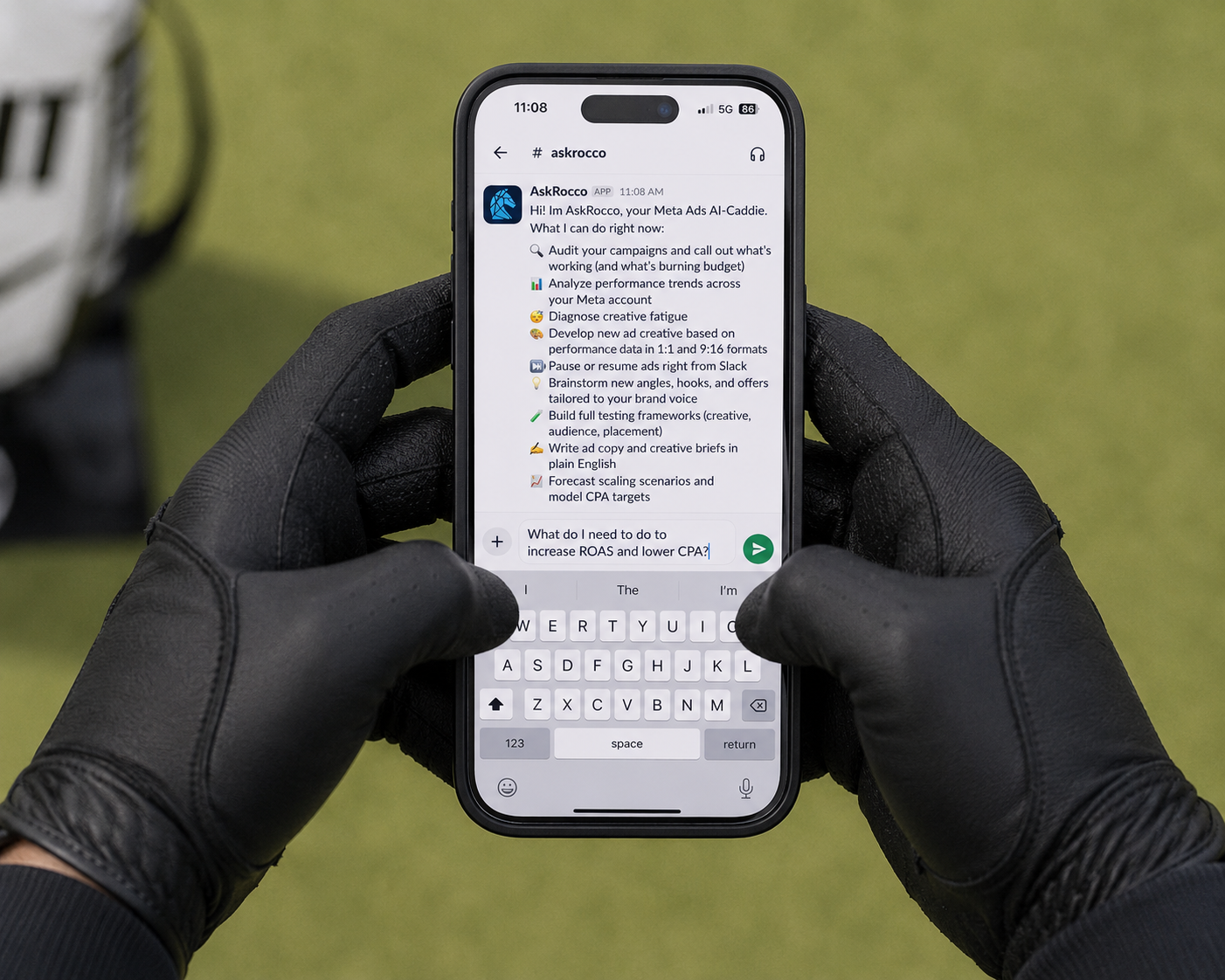
We built AskRocco because every advertiser deserves a caddie.
After 13 years and over $450M in Meta Ads managed across 500+ brands, I kept seeing the same pattern: great products losing to better systems. Not better creative. Not bigger budgets. A better performance marketing data strategy.
AskRocco reads your entire Meta Ads account every morning and delivers a full performance brief directly into your Slack. Not a dashboard. Not another chart to squint at. A clear action plan: what's working, what isn't, and exactly what to do next. That's what real Meta Ads management looks like. Then it executes those optimizations in one click through RoccoGo, and builds new creative from your top performers through RoccoCreate.
Aaron Rai reminded me this week that the fundamentals aren't boring. They're what win majors.
Two gloves. Iron covers. Wire-to-wire.
Distance to pin. Wind direction. Where to miss.
Your Meta Ads, finally playing like a professional.
Try AskRocco free. Daily performance brief in Slack. Takes two minutes to set up.
Your Meta Ads deserve a caddie.
Daily performance brief in Slack. Decisions, not dashboards. Takes two minutes to set up.
Try AskRocco Free · Book a Demo
.png)